What Is an Agentic Harness? The Scaffolding That Turns a Model Into an Agent
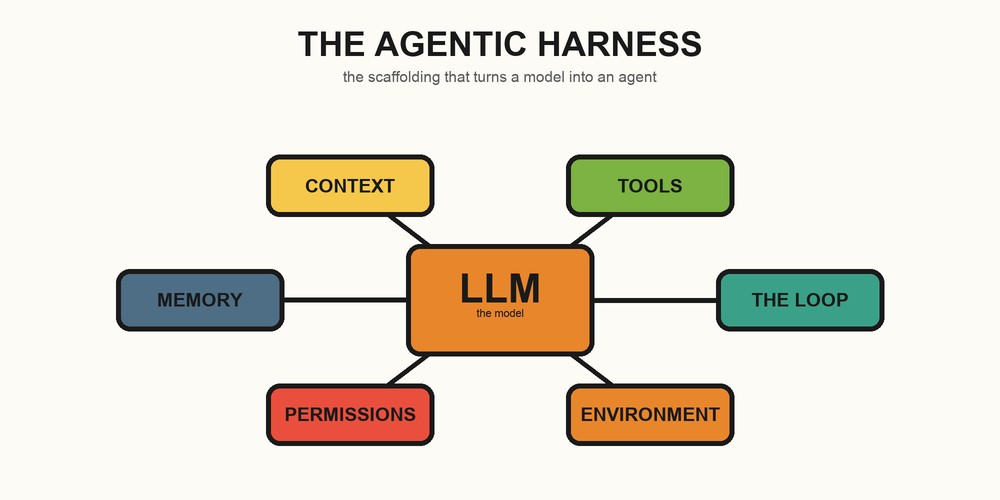
An agentic harness is the software scaffolding wrapped around a large language model (LLM) that turns it from a text generator into an agent that can plan, take actions, and finish real tasks. The model supplies the reasoning. The harness supplies everything else: the loop that keeps it working, the tools it can call, the context it sees, the memory it carries, the permissions that keep it safe, and the environment it runs in.
Put simply: the model is the engine, and the harness is the rest of the car. A brilliant engine sitting on the floor of a garage does not get you anywhere. Most of the value businesses are now extracting from AI comes not from a better engine, but from a better harness around it.
The model alone is not enough
A raw LLM does one thing: given some text, it predicts the next chunk of text. That is remarkably powerful, but on its own it cannot read your files, call your CRM, run a calculation, check whether its answer was correct, or try again when it fails. It answers once and stops.
Real work is rarely a single answer. Closing the books, triaging a support queue, researching a market, or writing and testing code all require many steps, the ability to use tools, and the judgment to course-correct along the way. The agentic harness is what supplies those missing pieces. It is the difference between an AI that talks about a task and an AI that does the task.
The six parts of an agentic harness
Most production-grade harnesses are built from the same six components. You can see them arranged around the model in the diagram above.
1. The loop
The defining feature of an agent is that it runs in a loop instead of answering once. The harness sends the model a goal, lets it decide on an action, executes that action, feeds the result back, and repeats until the job is done. This observe–think–act cycle is what lets an agent break a big task into steps, react to what it learns, and recover from mistakes rather than failing on the first obstacle.
2. Tools
Tools are the model’s hands. A tool is any function the harness exposes to the model: searching the web, querying a database, sending an email, running code, calling an internal API. The harness describes each tool to the model, lets the model request a tool call, runs it, and returns the result. Good tool design is one of the highest-leverage parts of building an agent. The right set of well-described tools often matters more than the choice of model.
3. Context
Context is everything the model can “see” at the moment it makes a decision: the user’s request, relevant documents, prior steps, and tool outputs. Because every model has a finite context window, the harness must constantly decide what to load, what to summarize, and what to leave out. Skillful context management, what to put in front of the model and when, is frequently the difference between an agent that stays on track and one that drifts or hallucinates.
4. Memory
Memory is what the agent carries beyond a single conversation: facts about the user, decisions made earlier, and lessons from past runs. Where context is short-term working memory, persistent memory lets an agent improve over time and pick up where it left off instead of starting cold every session.
5. Permissions
An agent that can act can also cause harm, so the harness governs what it is allowed to do. Permissions cover which tools require human approval, what data the agent may touch, and where hard stops sit. This is the guardrail layer, and for any business deployment it is not optional. The goal is an agent that is useful and trustworthy, not one that is merely capable.
6. Environment
Finally, the agent needs somewhere to operate: a sandbox, a file system, a browser, a code repository, or a connection to your live systems. The environment defines the agent’s reach. A well-scoped environment gives the agent enough access to be useful while containing the blast radius if something goes wrong.
You have probably already used one
Agentic harnesses are no longer theoretical. Coding assistants that read your repository, write changes, run the tests, and fix what breaks are agentic harnesses around a coding model. Research assistants that browse the web across dozens of pages and synthesize a report are agentic harnesses around a reasoning model. The underlying model in each case may be similar; the experience differs because the harness differs.
Why this matters for your business
If you are evaluating or building AI agents, the harness is where most of the practical decisions live:
- Reliability comes from the harness, not the model. Retries, validation, and the ability to recover from errors are properties of the loop and tooling, not of raw model intelligence.
- Differentiation comes from your tools and data. Any competitor can call the same model. What sets your agent apart is the tools, context, and proprietary data you connect it to.
- Trust comes from permissions. Customers and regulators care less about how clever your agent is and more about what it is allowed to do and who is accountable.
- Models will keep changing. A well-built harness lets you swap in a better model as it ships, without rebuilding everything around it. Invest in scaffolding that outlives any single model.
How to evaluate an agentic harness
When you assess a vendor’s agent or design your own, ask pointed questions about each part:
- Loop – How does it handle failure? Can it retry and self-correct, or does it give up?
- Tools – What can it actually do, and how easily can you add your own integrations?
- Context – How does it manage long tasks and large documents without losing the thread?
- Memory – Does it remember across sessions, and can you inspect or correct what it stores?
- Permissions – What requires human approval, and where are the hard limits?
- Environment – What systems can it reach, and how is the blast radius contained?
The takeaway
The model gets the headlines, but the agentic harness is where AI becomes a worker rather than a chatbot. As foundation models become widely available, your competitive edge will increasingly come from the quality of the scaffolding you build around them: the loop, the tools, the context, the memory, the permissions, and the environment. Get the harness right, and you turn a capable model into a dependable member of your team, one that helps you drive differentiation, win clients, and grow your business.